
For organizations in regulated industries such as government, healthcare, financial services, and forensics, secure data archiving has become essential for reducing risks and increasing resilience.
Companies are fueling an unprecedented surge in data creation — the latest estimates state that 400 million terabytes of data are generated each day. With so much information flowing through enterprise systems, managing what stays in production and what moves to long-term storage has never been more critical.
Secure data archiving allows inactive or infrequently accessed files to be securely moved to long-term storage while remaining accessible when needed. When implemented correctly, it improves performance, strengthens security, supports compliance, and reduces operational costs.
What is secure data archiving?
Modern data archiving goes far beyond moving old files to secondary storage. Unlike traditional backups, which are designed for short-term recovery, archives store inactive data for extended periods, often preserved in read-only or immutable formats to protect integrity.
Archived data must remain encrypted, searchable, retrievable and safe from ransomware, insider threats and unauthorized access for years or even decades. Moreover, practices must align with regulatory retention mandates and support legal defensibility.
As data volumes increase and compliance frameworks tighten, archiving strategies must be built into the storage architecture itself rather than treated as an afterthought.
The Business Benefits of Secure Data Archiving
A well-designed archiving strategy directly improves operational efficiency. By removing inactive data from production systems, organizations reduce system load and improve application performance. Backup processes become faster and more predictable because active datasets are smaller and more manageable.
Cost control is another major benefit. High performance primary storage is expensive. Archiving allows organizations to tier data appropriately, storing long term information on optimized infrastructure without sacrificing accessibility or security.
Compliance and governance requirements also drive the need for strong archiving practices. Many industries must retain records for defined periods and demonstrate chain of custody. A secure archive supports audit readiness, regulatory reporting, and forensic investigations without disrupting daily operations.
Storage Technologies Used for Data Archiving
Organizations typically use a combination of storage technologies to meet archiving goals. Traditional tape systems offer high capacity at lower cost but slower retrieval times. Disk and flash storage provide faster access but at a higher price point. Cloud-based archival storage offers scalability and geographic redundancy but introduces concerns around third party control and long-term cost predictability.
Increasingly, regulated organizations are adopting encrypted on-premises storage platforms to maintain full control over their data. This approach reduces exposure to external risk, preserves data sovereignty, and ensures encryption keys remain under direct organizational control.
SecureNAS® as a Modern Archiving Platform
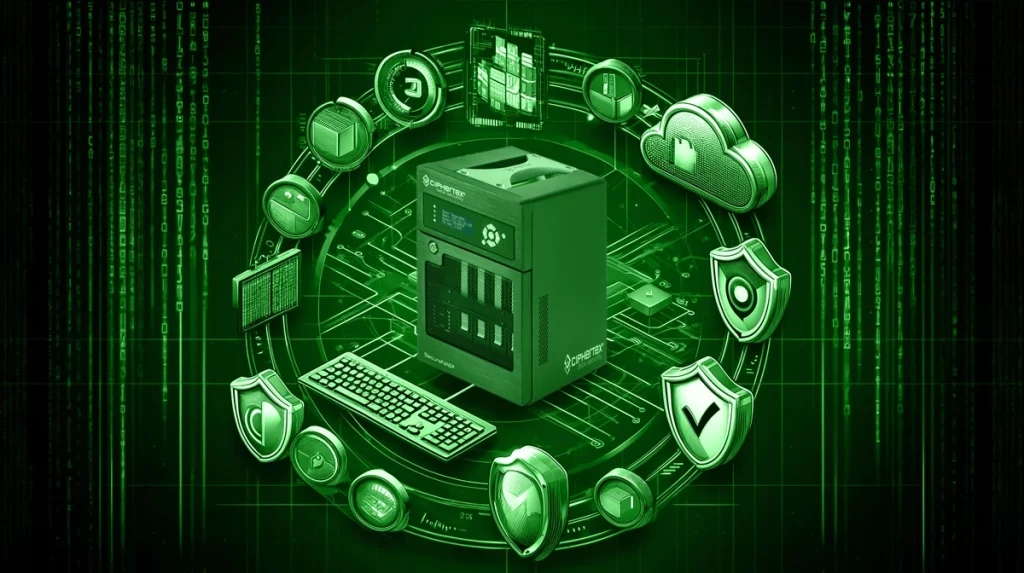
A strong example of a secure archiving solution is Ciphertex Data Security’s SecureNAS®. . It is designed for highly regulated environments, integrating encryption, performance, and scalability into a single platform.
SecureNAS® uses hardware-based encryption with secure key management to protect data at rest. Built on a ZFS storage architecture, it delivers data integrity, redundancy, and consistent performance across large datasets. Systems scale from portable deployments to multi-petabyte rackmount configurations, making them suitable for edge, enterprise, and data center environments.
Additionally, our solutions also support virtualization, containerized workloads, and AI-driven analytics. This allows archived datasets to serve not only compliance purposes but also supports training AI/ML models, forensic analysis, and operational intelligence.
Maintaining Compliance in Regulated Industries
Regulatory frameworks such as NIST guidelines, HIPAA requirements, CJIS standards, and various Department of Defense security mandates require secure long-term retention of sensitive information. Archiving solutions must enforce encryption, controlled access, and audit traceability by design.
SecureNAS® supports these environments by combining encrypted storage with secure access controls and scalable infrastructure. This makes it suitable for healthcare institutions preserving patient records, government agencies retaining investigative data, and financial institutions maintaining transaction histories.
Supporting Incident Response and AI
Archived data plays a vital role in cybersecurity and incident response. After a ransomware event or breach, organizations rely on secure, uncompromised archives to restore operations and conduct forensic investigations. Immutable, encrypted archives preserve evidence integrity and support legal defensibility.
At the same time, long term datasets are increasingly valuable for analytics and artificial intelligence. Historical data enables trend analysis, predictive modeling, and machine learning applications. A secure archiving platform ensures that these datasets remain protected while still being available for advanced processing when required.
Embracing Purpose-Built Storage Solutions for Long-Term Data Security
Many security leaders are rethinking how encryption, access control, and infrastructure design support resilience, audit readiness, and emerging AI initiatives. If you are one of them, get in touch to learn how Ciphertex’s ultra-secure, high-performance solutions can support your long-term security and data governance objectives.